NEODYMIUM OR FERRITE MAGNETS: WHICH ONE SHOULD YOU CHOOSE?
If you are looking to buy some Magnets Online, you’ll find out soon that you can choose from several different magnetic materials. The most common are Neodymium and Ferrite, but you can find AlNiCo Magnets, SmCo Magnets and Neodymium Magnets with different grades (N35, N42, N54 and more).
But which one should you buy? Let’s find out
KEY FACTS ABOUT NEODYMIUM MAGNETS
Neodymium magnets were first developed in 1982. Their main components are neodymium (a rare-earth element), iron, and boron; this chemical compound is known as NdFeB. They are the strongest commercially available permanent magnet. Depending on the magnetic grade, they are 10 to 18 times more powerful than a ferrite magnet of the same size!
Neodymium magnets have a very high coercivity (resistance to being demagnetize) but are quite brittle and must be handled with great care.
Standard neodymium magnets have a pretty low maximum working temperature (heat resistance) of around 80°C. This can be increased to up to 200°C in special heat resistant neodymium magnets.
Find out more about magnets and heat tolerance in our dedicated article: Permanent Magnets and Heat Resistance: the best magnets to use
Without a coating (usually zinc or nickel) or a container (PVC, resin, rubber), they can oxidize or rust easily (due to their iron content).
Neodymium magnets are quite expensive primarily due to the cost of raw rare-earth elements (neodymium), the highly complex and energy-intensive manufacturing, and the surging demand for many modern application (electric motors, green energy sector, electronics). The main mining areas are in China (80-90% of global production), United States, Brazil, India, Sri Lanka, and Australia. Supply fluctuations and tariffs can easily spike the price of neodymium magnets.
If you are looking for maximum performance relative to the size, and don’t care too much about the price or other factors, Neodymium Magnets are the right choice.
You can learn more about Neodymium Magnets in our dedicated article: NEODYMIUM MAGNETS: THE COMPLETE GUIDE
KEY FACTS ABOUT FERRITE MAGNETS
Ferrite Magnets were the first type of magnets to be widely used. The original ferrite compound was developed in Japan by Dr. Yogoro Kato and Dr. Takeshi Takei at Tokyo Institute of Technology in 1930. Ferrite is an iron-oxide-containing magnetic ceramic materials (these magnets are also known as ceramic magnets). Unlike other ferromagnetic materials, most ferrites are not electrically-conductive.
These magnets do not have the same adhesive force as neodymium ones, but they have other advantages, mainly: low cost, good resilience, great resitance to heat, corrosion and demagnetization.
You can learn more about ferrite magnets in our dedicated article FERRITE MAGNETS: THE COMPLETE GUIDE
NEODYMIUM MAGNETS VS FERRITE MAGNETS COMPARISON TABLE
KEY FEATURES | NEODYMIUM | FERRITE |
|---|---|---|
APPEARANCE | Metallic, polish and smooth | Dark grey |
MAGNETIC STRENGTH | 8-16 times stronger than ferrite.
Depending on the grade | Weaker than neodymium |
RUST AND CORROSION RESISTANCE | Not very good. Can be made with special coatings or be protected by a container | Very high |
STRUCTURAL INTEGRITY | Quite brittle, can break easily. Must be handled with care | Hard and sturdy |
HEAT RESISTANCE | Up to 80°C. Special heat resistant magnets can go up to 200°C | Up to 250°C |
PRICE | Quite expensive. The greater the grade (neodymium content), the higher the price | Very cheap |
NEODYMIUM VS FERRITE MAGNETS PRICE COMPARISON TABLE
| MAGNET | FERRITE | NEODYMIUM N35 GRADE |
| Disc D.10X4 mm | 0,07 € | 0,23 € |
| Disc D.16X3 mm | 0,08 € | 0,75 € |
| Disc D.20X10 mm | 0,09 € | 1,70 € |
| Disc D.30X10 mm | 0,29 € | 3,54 € |
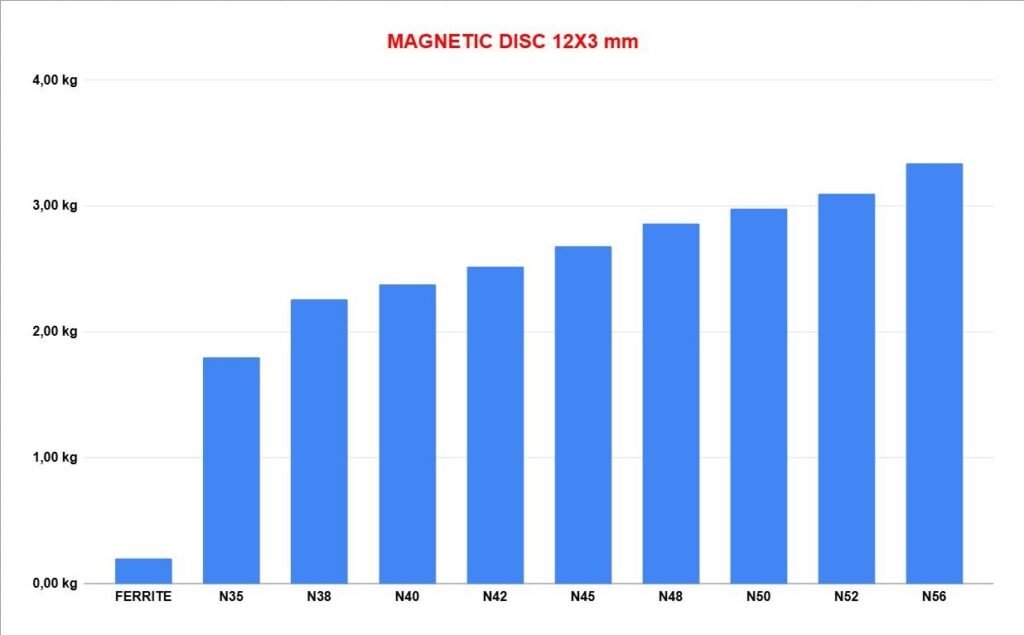
NEODYMIUM VS FERRITE MAGNETS MAGNETIC STRENGTH COMPARISON TABLE
| MAGNET | FERRITE | N35 | N38 | N40 | N42 |
| Disc D.12X3 mm | 0,20 kg | 1,80 kg | 2,26 kg | 2,38 kg | 2,52 kg |
| Disc D.20X2 mm | 0,30 kg | 2,30 kg | 2,54 kg | 2,68 kg | 2,81 kg |
| Disc D.25X3 mm | 0,45 kg | 4,28 kg | 4,84 kg | 5,09 kg | 5,35 kg |
| Disc D.30X10 mm | 2,20 kg | 16,00 kg | 19,38 kg | 20,40 kg | 21,41 kg |
| MAGNET | N45 | N48 | N50 | N52 | N56 |
| Disc D.12X3 mm | 2,68 kg | 2,86 kg | 2,98 kg | 3,10 kg | 3,34 kg |
| Disc D.20X2 mm | 3,01 kg | 3,21 kg | 3,25 kg | 3,48 kg | 3,75 kg |
| Disc D.25X3 mm | 5,73 kg | 6,11 kg | 6,37 kg | 6,63 kg | 7,15 kg |
| Disc D.30X10 mm | 22,95 kg | 24,48 kg | 25,50 kg | 26,52 kg | 28,55 kg |
NEODYMIUM VS FERRITE MAGNETS MAGNETIC STRENGTH COMPARISON CHART
NEODYMIUM AND FERRITE MAGNETS FAQ
Which magnets are the strongest?
Neodymium Magnets are strongest commercially available permanent magnet. They are 8 to 16 times stronger than a Ferrite Magnet, depending on shape, size and neodymium grade.
Check out our blog post How strong is a Neodymium Magnet?
What is the grade of a Neodymium Magnet? What does the letter N stand for?
The grade of a Neodymium magnet indicates its magnetic strength – the higher the grade, the stronger the magnet. This grade is indicated by the letter N followed by a number (usually 35 up to 56). It is linked to the magnetic flux output per unit of volume, and increases with the quantity of Neodymium present in the magnet. Standard neodymium magnets are usually N35 but you can find N38, N40, N42, N45, N48, N50, N52, N56 grades.
Check out our High Performance Magnets Category
Which Magnets are more resistant to high temperatures?
The magnets with the higher heat resistance are made of AlNiCo, an alloy of Iron, Alluminium, Nickel, Cobalt and other elements in lesser concentration (hence the acronym Al-Ni-Co). They boast a working temperature of up to 650 °C.
Standard Neodymium magnets have a maximum working temperature of 80 °C, but specially manufactured ones can reach up to 200 °C.
Ferrite magnets have a working temperature of 250°C and up to that threshold they maintain optimal performances.
Check out our article Permanent Magnets and Heat Resistance and our Heat Resistant Magnets Page
Which magnets are more resistant to rust and corrosion?
Ferrite Magnets are made with iron oxide, and, as a result, they do not rust even when submerged in water. They are very resistant to corrosion and chemicals in general.
Neodymium Magnets tend to be more vulnerable to rust and corrosion. To prevent degradation and loss of performance, a protective coating(plating) can be added, usually Nickel or Zinc. Another option is to insert the magnet in a container made of Stainless Steel, Rubber or PVC.
Check out our article Loss of magnetization and demagnetisation of permanent magnets
Which are the cheapest magnets?
Should I buy Ferrite or Neodymium Magnets? Which is best?
It really depends a lot on your needs. Neodymium Magnets look smooth and shiny. They are more powerful, but also more expensive.
Ferrite Magnets look darker and rougher. They are the cheapest option, but have a lower adhesive force. Ferrite magnets are also more robust and resistant to corrosion, oxidation and high temperatures.